











On 11 November, H.E. Yang Xiaoguang, Chinese Ambassador to PNG publishes a byline article to PNG's media Post-Courier and The National entitled "Persevering with Full and Rigorous Party Self-Governance: The Success Code of a Century-Old Party in Its Prime". The full text is as follows:
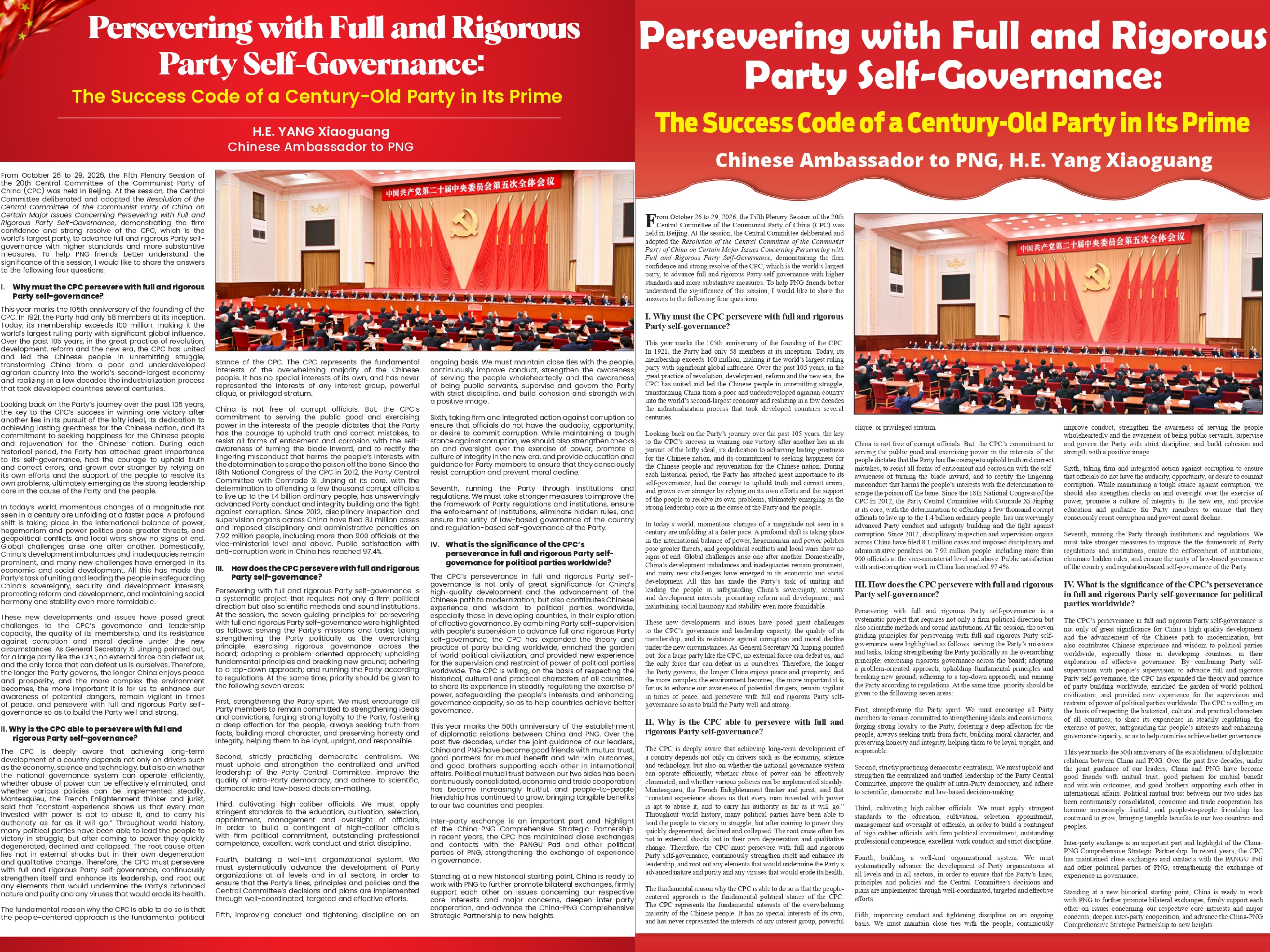
From October 26 to 29, 2026, the Fifth Plenary Session of the 20th Central Committee of the Communist Party of China (CPC) was held in Beijing. At the session, the Central Committee deliberated and adopted the Resolution of the Central Committee of the Communist Party of China on Certain Major Issues Concerning Persevering with Full and Rigorous Party Self-Governance, demonstrating the firm confidence and strong resolve of the CPC, which is the world’s largest party, to advance full and rigorous Party self-governance with higher standards and more substantive measures. To help PNG friends better understand the significance of this session, I would like to share the answers to the following four questions.
I. Why must the CPC persevere with full and rigorous Party self-governance?
This year marks the 105th anniversary of the founding of the CPC. In 1921, the Party had only 58 members at its inception. Today, its membership exceeds 100 million, making it the world’s largest ruling party with significant global influence. Over the past 105 years, in the great practice of revolution, development, reform and the new era, the CPC has united and led the Chinese people in unremitting struggle, transforming China from a poor and underdeveloped agrarian country into the world’s second-largest economy and realizing in a few decades the industrialization process that took developed countries several centuries.
Looking back on the Party’s journey over the past 105 years, the key to the CPC’s success in winning one victory after another lies in its pursuit of the lofty ideal, its dedication to achieving lasting greatness for the Chinese nation, and its commitment to seeking happiness for the Chinese people and rejuvenation for the Chinese nation. During each historical period, the Party has attached great importance to its self-governance, had the courage to uphold truth and correct errors, and grown ever stronger by relying on its own efforts and the support of the people to resolve its own problems, ultimately emerging as the strong leadership core in the cause of the Party and the people.
In today’s world, momentous changes of a magnitude not seen in a century are unfolding at a faster pace. A profound shift is taking place in the international balance of power, hegemonism and power politics pose greater threats, and geopolitical conflicts and local wars show no signs of end. Global challenges arise one after another. Domestically, China’s development imbalances and inadequacies remain prominent, and many new challenges have emerged in its economic and social development. All this has made the Party’s task of uniting and leading the people in safeguarding China’s sovereignty, security and development interests, promoting reform and development, and maintaining social harmony and stability even more formidable.
These new developments and issues have posed great challenges to the CPC’s governance and leadership capacity, the quality of its membership, and its resistance against corruption and moral decline under the new circumstances. As General Secretary Xi Jinping pointed out, for a large party like the CPC, no external force can defeat us, and the only force that can defeat us is ourselves. Therefore, the longer the Party governs, the longer China enjoys peace and prosperity, and the more complex the environment becomes, the more important it is for us to enhance our awareness of potential dangers, remain vigilant in times of peace, and persevere with full and rigorous Party self-governance so as to build the Party well and strong.
II. Why is the CPC able to persevere with full and rigorous Party self-governance?
The CPC is deeply aware that achieving long-term development of a country depends not only on drivers such as the economy, science and technology, but also on whether the national governance system can operate efficiently, whether abuse of power can be effectively eliminated, and whether various policies can be implemented steadily. Montesquieu, the French Enlightenment thinker and jurist, said that “constant experience shows us that every man invested with power is apt to abuse it, and to carry his authority as far as it will go.” Throughout world history, many political parties have been able to lead the people to victory in struggle, but after coming to power they quickly degenerated, declined and collapsed. The root cause often lies not in external shocks but in their own degeneration and qualitative change. Therefore, the CPC must persevere with full and rigorous Party self-governance, continuously strengthen itself and enhance its leadership, and root out any elements that would undermine the Party’s advanced nature and purity and any viruses that would erode its health.
The fundamental reason why the CPC is able to do so is that the people-centered approach is the fundamental political stance of the CPC. The CPC represents the fundamental interests of the overwhelming majority of the Chinese people. It has no special interests of its own, and has never represented the interests of any interest group, powerful clique, or privileged stratum.
China is not free of corrupt officials. But, the CPC’s commitment to serving the public good and exercising power in the interests of the people dictates that the Party has the courage to uphold truth and correct mistakes, to resist all forms of enticement and corrosion with the self-awareness of turning the blade inward, and to rectify the lingering misconduct that harms the people’s interests with the determination to scrape the poison off the bone. Since the 18th National Congress of the CPC in 2012, the Party Central Committee with Comrade Xi Jinping at its core, with the determination to offending a few thousand corrupt officials to live up to the 1.4 billion ordinary people, has unswervingly advanced Party conduct and integrity building and the fight against corruption. Since 2012, disciplinary inspection and supervision organs across China have filed 8.1 million cases and imposed disciplinary and administrative penalties on 7.92 million people, including more than 900 officials at the vice-ministerial level and above. Public satisfaction with anti-corruption work in China has reached 97.4%.
III. How does the CPC persevere with full and rigorous Party self-governance?
Persevering with full and rigorous Party self-governance is a systematic project that requires not only a firm political direction but also scientific methods and sound institutions. At the session, the seven guiding principles for persevering with full and rigorous Party self-governance were highlighted as follows: serving the Party’s missions and tasks; taking strengthening the Party politically as the overarching principle; exercising rigorous governance across the board; adopting a problem-oriented approach; upholding fundamental principles and breaking new ground; adhering to a top-down approach; and running the Party according to regulations. At the same time, priority should be given to the following seven areas:
First, strengthening the Party spirit. We must encourage all Party members to remain committed to strengthening ideals and convictions, forging strong loyalty to the Party, fostering a deep affection for the people, always seeking truth from facts, building moral character, and preserving honesty and integrity, helping them to be loyal, upright, and responsible.
Second, strictly practicing democratic centralism. We must uphold and strengthen the centralized and unified leadership of the Party Central Committee, improve the quality of intra-Party democracy, and adhere to scientific, democratic and law-based decision-making.
Third, cultivating high-caliber officials. We must apply stringent standards to the education, cultivation, selection, appointment, management and oversight of officials, in order to build a contingent of high-caliber officials with firm political commitment, outstanding professional competence, excellent work conduct and strict discipline.
Fourth, building a well-knit organizational system. We must systematically advance the development of Party organizations at all levels and in all sectors, in order to ensure that the Party’s lines, principles and policies and the Central Committee’s decisions and plans are implemented through well-coordinated, targeted and effective efforts.
Fifth, improving conduct and tightening discipline on an ongoing basis. We must maintain close ties with the people, continuously improve conduct, strengthen the awareness of serving the people wholeheartedly and the awareness of being public servants, supervise and govern the Party with strict discipline, and build cohesion and strength with a positive image.
Sixth, taking firm and integrated action against corruption to ensure that officials do not have the audacity, opportunity, or desire to commit corruption. While maintaining a tough stance against corruption, we should also strengthen checks on and oversight over the exercise of power, promote a culture of integrity in the new era, and provide education and guidance for Party members to ensure that they consciously resist corruption and prevent moral decline.
Seventh, running the Party through institutions and regulations. We must take stronger measures to improve the the framework of Party regulations and institutions, ensure the enforcement of institutions, eliminate hidden rules, and ensure the unity of law-based governance of the country and regulation-based self-governance of the Party.
IV. What is the significance of the CPC’s perseverance in full and rigorous Party self-governance for political parties worldwide?
The CPC’s perseverance in full and rigorous Party self-governance is not only of great significance for China’s high-quality development and the advancement of the Chinese path to modernization, but also contributes Chinese experience and wisdom to political parties worldwide, especially those in developing countries, in their exploration of effective governance. By combining Party self-supervision with people’s supervision to advance full and rigorous Party self-governance, the CPC has expanded the theory and practice of party building worldwide, enriched the garden of world political civilization, and provided new experience for the supervision and restraint of power of political parties worldwide. The CPC is willing, on the basis of respecting the historical, cultural and practical characters of all countries, to share its experience in steadily regulating the exercise of power, safeguarding the people’s interests and enhancing governance capacity, so as to help countries achieve better governance.
This year marks the 50th anniversary of the establishment of diplomatic relations between China and PNG. Over the past five decades, under the joint guidance of our leaders, China and PNG have become good friends with mutual trust, good partners for mutual benefit and win-win outcomes, and good brothers supporting each other in international affairs. Political mutual trust between our two sides has been continuously consolidated, economic and trade cooperation has become increasingly fruitful, and people-to-people friendship has continued to grow, bringing tangible benefits to our two countries and peoples.
Inter-party exchange is an important part and highlight of the China-PNG Comprehensive Strategic Partnership. In recent years, the CPC has maintained close exchanges and contacts with the PANGU Pati and other political parties of PNG, strengthening the exchange of experience in governance.
Standing at a new historical starting point, China is ready to work with PNG to further promote bilateral exchanges, firmly support each other on issues concerning our respective core interests and major concerns, deepen inter-party cooperation, and advance the China-PNG Comprehensive Strategic Partnership to new heights.